If you have been prescribed compounded Tirzepatide (the active ingredient in Mounjaro® and Zepbound®) for weight loss or blood sugar management, you are likely using a vial and an insulin syringe. This can lead to a lot of confusion, especially when trying to figure out how the liquid volume in the syringe (units) translates to your actual medication dose (milligrams).
Mixing up "units" and "mg" is one of the most common—and potentially dangerous—mistakes patients make.
In this guide, we will break down exactly how to convert your dosage, answer the most frequently asked questions about specific unit-to-mg conversions, and provide a clear, easy-to-read tirzepatide dosage chart.
Before answering specific conversion questions, you must understand the difference between units and milligrams:
Units (Liquid Volume): This is what you see printed on the side of your insulin syringe. On a standard U-100 insulin syringe, 100 units equal 1 milliliter (1 mL).
Milligrams (mg): This is the actual strength or "weight" of the medication dose you are taking (e.g., a 2.5 mg or 5 mg dose).
To convert units to mg, you must know the concentration of your vial.
Compounding pharmacies mix Tirzepatide in different strengths. The two most common concentrations in the US are:
10 mg/mL (10 milligrams of medication per 1 milliliter of liquid)
20 mg/mL (20 milligrams of medication per 1 milliliter of liquid)
Note: Some pharmacies use unique concentrations like 17.2 mg/mL or 8 mg/mL. Always check your label. For the FAQs below, we will provide answers based on the standard 10 mg/mL and 20 mg/mL concentrations.
If you are looking at your syringe and wondering how much medication you are actually drawing up, here are the direct answers to the most common search queries based on standard pharmacy concentrations.
If your prescribed dose is 5 mg (the first maintenance dose), the number of units you draw depends on your vial's concentration:
If your vial is 10 mg/mL, you will pull 50 units (0.5 mL) into the syringe.
If your vial is 20 mg/mL, you will pull 25 units (0.25 mL) into the syringe.
7.5 mg is the second step-up dose in the standard Tirzepatide titration schedule.
If your vial is 10 mg/mL, you will draw 75 units (0.75 mL).
If your vial is 20 mg/mL, you will draw 37.5 units (round according to your doctor's instructions, usually using a half-unit syringe).
If you pull exactly 20 units into your insulin syringe:
From a 10 mg/mL vial, you are taking a dose of 2.0 mg.
From a 20 mg/mL vial, you are taking a dose of 4.0 mg.
If you draw 30 units of liquid into your syringe:
From a 10 mg/mL vial, your dose is 3.0 mg.
From a 20 mg/mL vial, your dose is 6.0 mg.
(Note: If your pharmacy uses a 17.2 mg/mL concentration, 30 units equals roughly 5.0 mg).
If you measure 40 units on your syringe:
From a 10 mg/mL vial, you are injecting 4.0 mg of Tirzepatide.
From a 20 mg/mL vial, you are injecting 8.0 mg of Tirzepatide.
50 units is exactly half of a standard U-100 insulin syringe (0.5 mL).
From a 10 mg/mL vial, 50 units equals a 5.0 mg dose.
From a 20 mg/mL vial, 50 units equals a 10.0 mg dose.
The standard protocol for Tirzepatide involves starting at a low dose to allow your body (and gastrointestinal system) to adjust, then slowly titrating up every 4 weeks as needed.
Below is a helpful tirzepatide dosage chart showing the standard dosing schedule and how that translates to syringe units based on the two most common vial concentrations.
Dosing PhasePrescribed Dose (mg)Units to Draw (If vial is 10mg/mL)Units to Draw (If vial is 20mg/mL)Weeks 1-4 (Initiation)2.5 mg25 units12.5 unitsWeeks 5-8 (Maintenance 1)5.0 mg50 units25 unitsWeeks 9-12 (Titration)7.5 mg75 units37.5 unitsWeeks 13-16 (Maintenance 2)10.0 mg100 units (1 full syringe)50 unitsWeeks 17-20 (Titration)12.5 mgConsult Pharmacy*62.5 unitsWeeks 21+ (Max Dose)15.0 mgConsult Pharmacy*75 units
(Note: If you are on a 12.5 mg or 15 mg dose, pharmacies rarely provide a 10 mg/mL vial, as it would require injecting more than one full 100-unit syringe at a time. Higher doses are almost always provided in higher concentrations).
Never Assume Your Concentration: Just because your last vial was 10 mg/mL does not mean your refill will be. Pharmacies often increase the concentration of the liquid as your dose increases so you don't have to inject large volumes of fluid. Always read the new label.
Use the Right Syringe: Always use the U-100 insulin syringes provided by your pharmacy. Never try to measure units in a larger, non-insulin syringe.
When in Doubt, Call: If your prescription says "Inject 50 units" but you don't know how many milligrams that is, or if the math isn't adding up, stop. Call your prescribing doctor or the compounding pharmacy's hotline. A 5-minute phone call can prevent a severe medication overdose.
Tirzepatide is prescribed under the brand names Mounjaro (for type 2 diabetes) and Zepbound (for weight loss).
While the indication might differ, both medications typically follow the same subcutaneous (under-the-skin), once-weekly dosing and titration schedule. This gradual increase helps manage potential gastrointestinal side effects like nausea and vomiting as your body adjusts to the medication.
Disclaimer: This information is for educational purposes only and does not constitute medical advice. Dosage schedules are individualized. Always consult your healthcare provider before starting, stopping, or changing your medication.
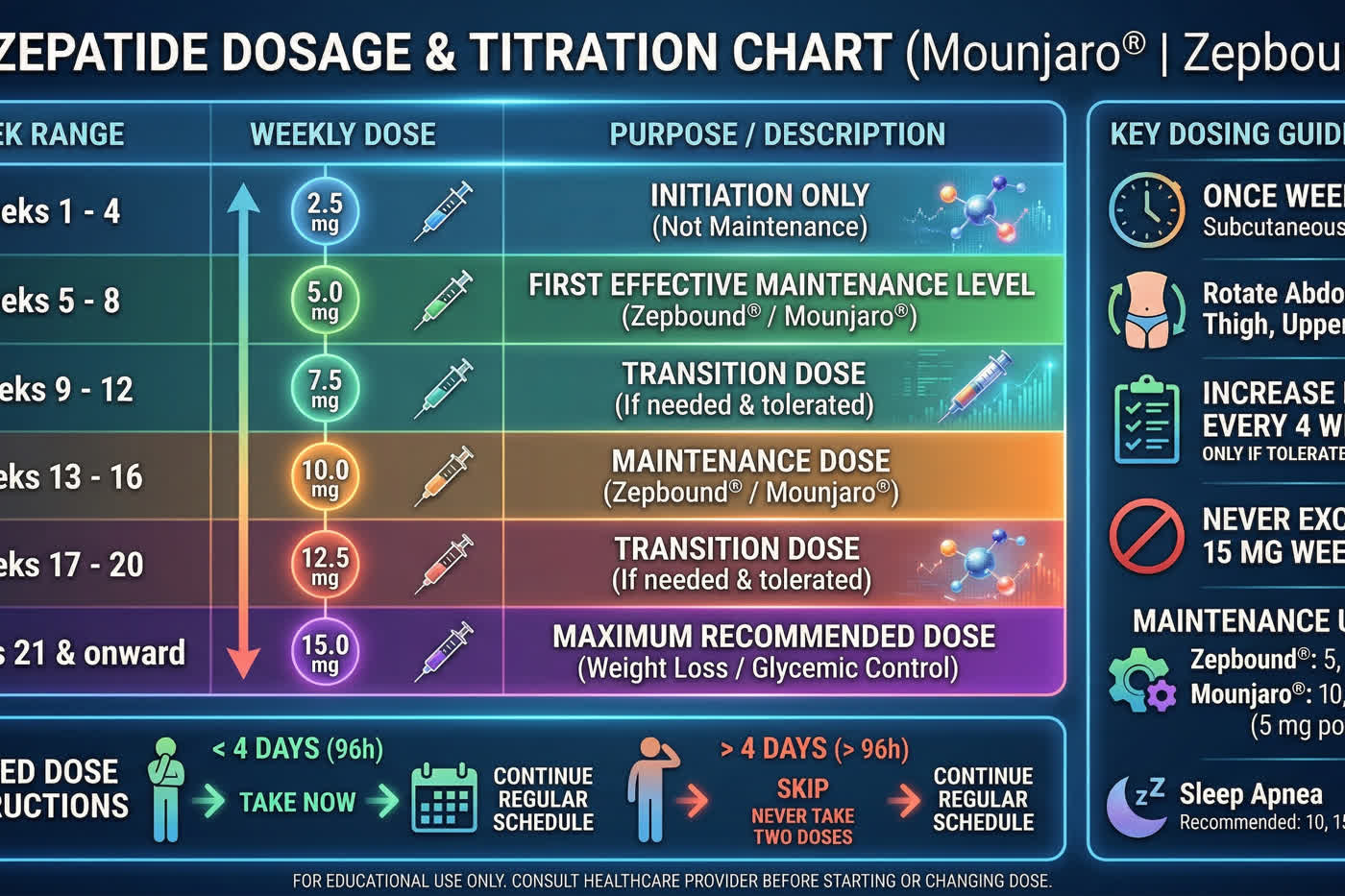
The typical schedule begins with an introductory dose and escalates every four weeks until a suitable maintenance level is reached.
Timeline (Weeks)Weekly DosePurposeWeeks 1 - 42.5 mgInitiation only. Sets the foundation; not meant for effective maintenance or glycemic control.Weeks 5 - 85.0 mgMaintenance dose. First effective maintenance level for weight loss or diabetes.Weeks 9 - 127.5 mgTransition dose, taken if further progress is needed and 5 mg is tolerated.Weeks 13 - 1610.0 mgMaintenance dose. Taken if further progress is needed and 7.5 mg is tolerated.Weeks 17 - 2012.5 mgTransition dose, taken if further progress is needed and 10 mg is tolerated.Weeks 21 & onward15.0 mgMaximum weekly dose. Taken if further progress is needed and 12.5 mg is tolerated.
Frequency: Subcutaneous injection once weekly, at any time of day, with or without meals.
Injection Sites: Rotate sites each week to the abdomen, thigh, or upper arm.
Dose Increases: Dose escalation should only occur every four weeks and only if the current dose is tolerated by the patient and additional control is needed.
Maximum Dose: The maximum recommended dosage of tirzepatide is 15 mg once weekly.
Maintenance Doses:
Zepbound (Weight Loss): Standard maintenance dosages are 5 mg, 10 mg, or 15 mg once weekly.
Mounjaro (Diabetes): Standard maintenance dosages are 10 mg or 15 mg once weekly, though 5 mg can be effective for some patients.
Sleep Apnea: For sleep apnea associated with obesity, the recommended maintenance doses are typically 10 mg or 15 mg once weekly.
Compounded tirzepatide dosing can be more variable, as concentration may differ among compounding pharmacies. However, a common dosing plan that mirrors the standard patented version looks like this. Always double-check the mg strength versus the "units" measurement on your specific syringe and prescription.
TimelineTypical Compounded DoseFrequencyMonth 12-3 mgOnce weeklyMonth 24-6 mgOnce weeklyMonth 36-8 mgOnce weeklyMonth 48-10 mgOnce weekly (if tolerated)Month 510-12 mgOnce weekly (if needed/tolerated)Month 6 onward12-14 mgOnce weekly (if needed/tolerated)Compounded MaxTypically 14-15 mgNever exceed maximum dosage
Under 4 days missed (96 hours): Administer the missed dose as soon as possible. Then, resume the next dose on the regularly scheduled day.
Over 4 days missed (96 hours): Skip the missed dose entirely and administer the next dose on the regularly scheduled day. Do not take two doses at the same time to make up for a missed one.