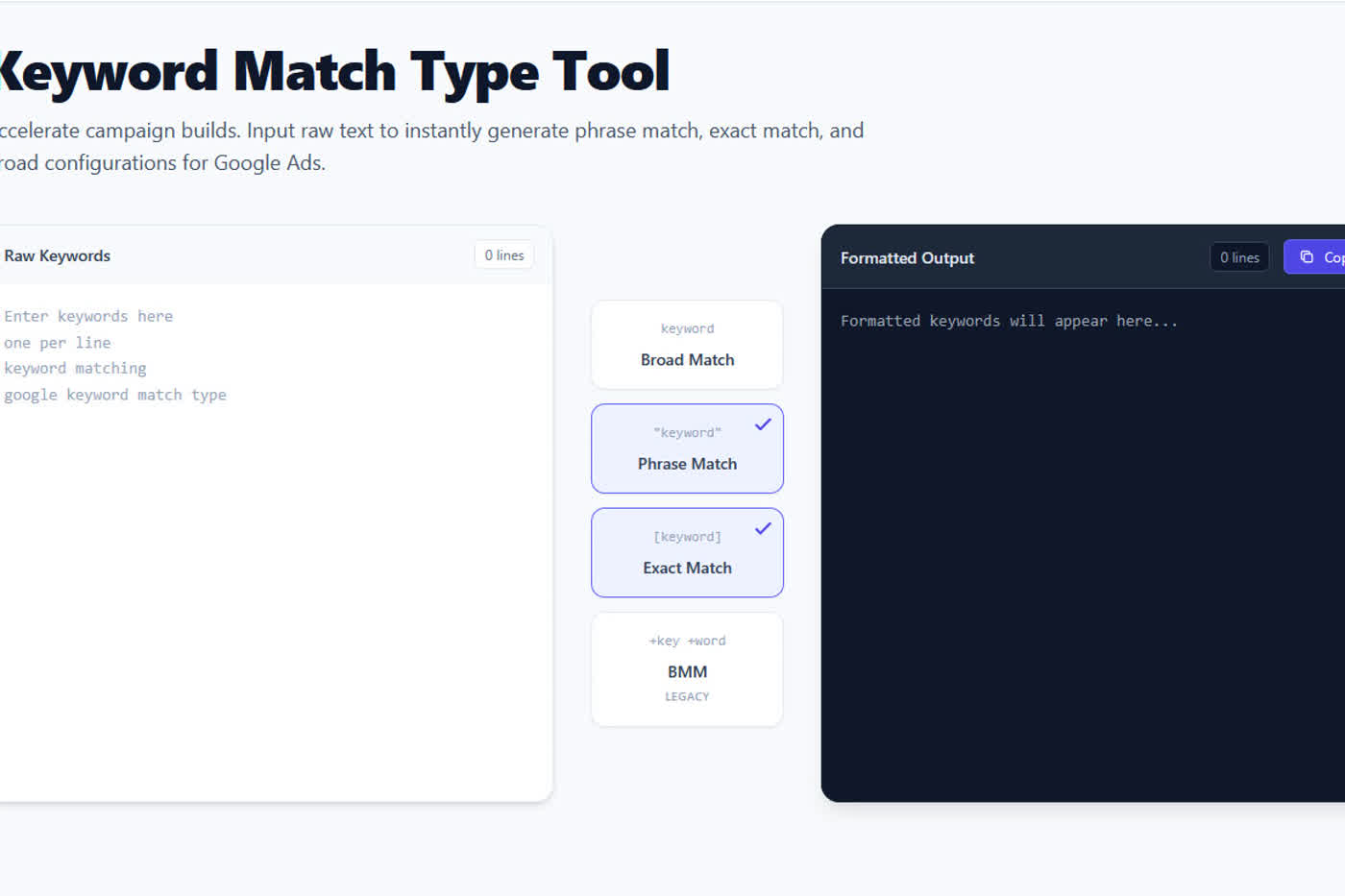
A keyword match type tool is a specialized utility designed to instantly wrap raw search terms in the specific syntax required by Google Ads, including Phrase Match ("keyword") and Exact Match ([keyword]). By automating the conversion process, these tools eliminate manual formatting errors, optimize your Quality Score, and allow you to deploy granular campaign structures like STAGs (Single Theme Ad Groups) in seconds. In 2026’s landscape of AI-driven bidding, maintaining precise keyword matching types remains the primary way to provide high-quality data signals to Google’s Smart Bidding algorithms.
👉 Enter Keywords into Keyword Match Type Tool here
Efficiency: Instantly convert thousands of keywords from broad to phrase or exact match.
Precision: Avoid the common syntax errors that lead to wasted ad spend.
Control: Use formatted keywords to guide Google's AI toward high-intent traffic.
Compatibility: Works seamlessly with the 2026 Google Ads Editor and web interface.
Here is the reality: Despite Google’s push toward "Broad Match + Smart Bidding," top-tier advertisers still rely on specific keyword matching to protect their budgets. Relying solely on broad match can lead to "query creep," where your ads appear for irrelevant terms that have no conversion intent.
👉 Action Required: Enter Keywords into Keyword Match Type Tool here
Using a keyword match type tool allows you to maintain a "hybrid" strategy. This involves using Broad Match for discovery and Exact/Phrase match for high-converting "money" terms.
Why does this matter? According to industry standards on Search Engine Marketing, control over keyword semantics is the leading factor in reducing Cost Per Acquisition (CPA). By using the right tools, you ensure your Google Ads match types are perfectly aligned with your campaign goals.
👉 Action Required: Enter Keywords into Keyword Match Type Tool here
Follow this tutorial to streamline your workflow and deploy keywords like a professional.
👉 Action Required:Enter Keywords into Keyword Match Type Tool here
Start by gathering your seed keywords from your favorite research tool or the Google Keyword Planner. At this stage, your keywords are likely in "Broad Match" format (no symbols).
Navigate to the Keyword Match Type Tool. This specific tool is optimized for the 2026 Google Ads API, ensuring that the syntax generated is 100% compliant with current ad platform requirements.
Paste your list into the input field. You will typically see options for:
Broad Match: No change.
Phrase Match: Adds quotation marks (" ").
Exact Match: Adds brackets ([ ]).
Negative Match: Adds a minus sign (-) or wraps in brackets for negative exact.
Click the "Convert" or "Generate" button. The tool will process the list using a logic-based script that handles special characters and casing.
The best part? You can copy the formatted results directly into your "Keywords" column in Google Ads Editor or the web interface. Because the tool has already applied the keyword matching syntax, Google will automatically recognize the intended match type.
In 2026, the definitions of match types have been refined by Google's AI updates. Here is how to use them effectively:
👉 Action Required:Enter Keywords into Keyword Match Type Tool here
This is no longer about identical characters; it is about identical intent. Use a keyword match tool to wrap your highest-converting terms in brackets to tell Google you only want traffic that matches the specific meaning of that term.
Phrase match includes the meaning of your keyword. It is the "Goldilocks" of keyword matching—not too broad, not too restrictive. Using a phrase match tool is essential when you want to capture searches that include your core term within a longer query.
Broad match (no syntax) is the default. While it offers the most reach, it requires a robust list of negative keywords.
Let’s dive deeper into advanced implementation.
Clean Your List First: Before using a keyword matching types tool, remove any duplicates or non-standard characters to prevent import errors.
The "Broad to Phrase" Shift: Many experts now recommend moving away from pure broad match for brand-protection campaigns. Use a broad to phrase match tool to quickly convert your brand terms into protected "Phrase" versions.
Negative Keyword Mining: Use the tool to generate your negative keyword lists. If you find a recurring irrelevant term, use the tool to wrap it in "Negative Exact" syntax to block it entirely.
The bottom line? Manual formatting is a relic of the past. To compete in 2026, you need to use a google ads match type tool to maintain the speed and precision required by modern PPC.
The Keyword Match Type Tool is widely considered the top choice due to its speed, lack of intrusive ads, and support for bulk processing of thousands of terms simultaneously.
No. In 2021, Google phased out Broad Match Modifier and folded its functionality into Phrase Match. If you are looking for a broad match modifier tool, you should now use a Phrase Match tool to achieve similar, more modern results.
Yes, but it is not recommended in 2026. For the best data signals, try to keep your ad groups themed by intent. Use a google keyword match type tool to separate your lists so you can test performance between Exact and Phrase match versions of the same query.
The fastest way is to use a dedicated broad to phrase match tool. Simply paste your broad terms, select "Phrase Match," and the tool will instantly wrap each line in quotation marks, ready for upload to Google Ads.