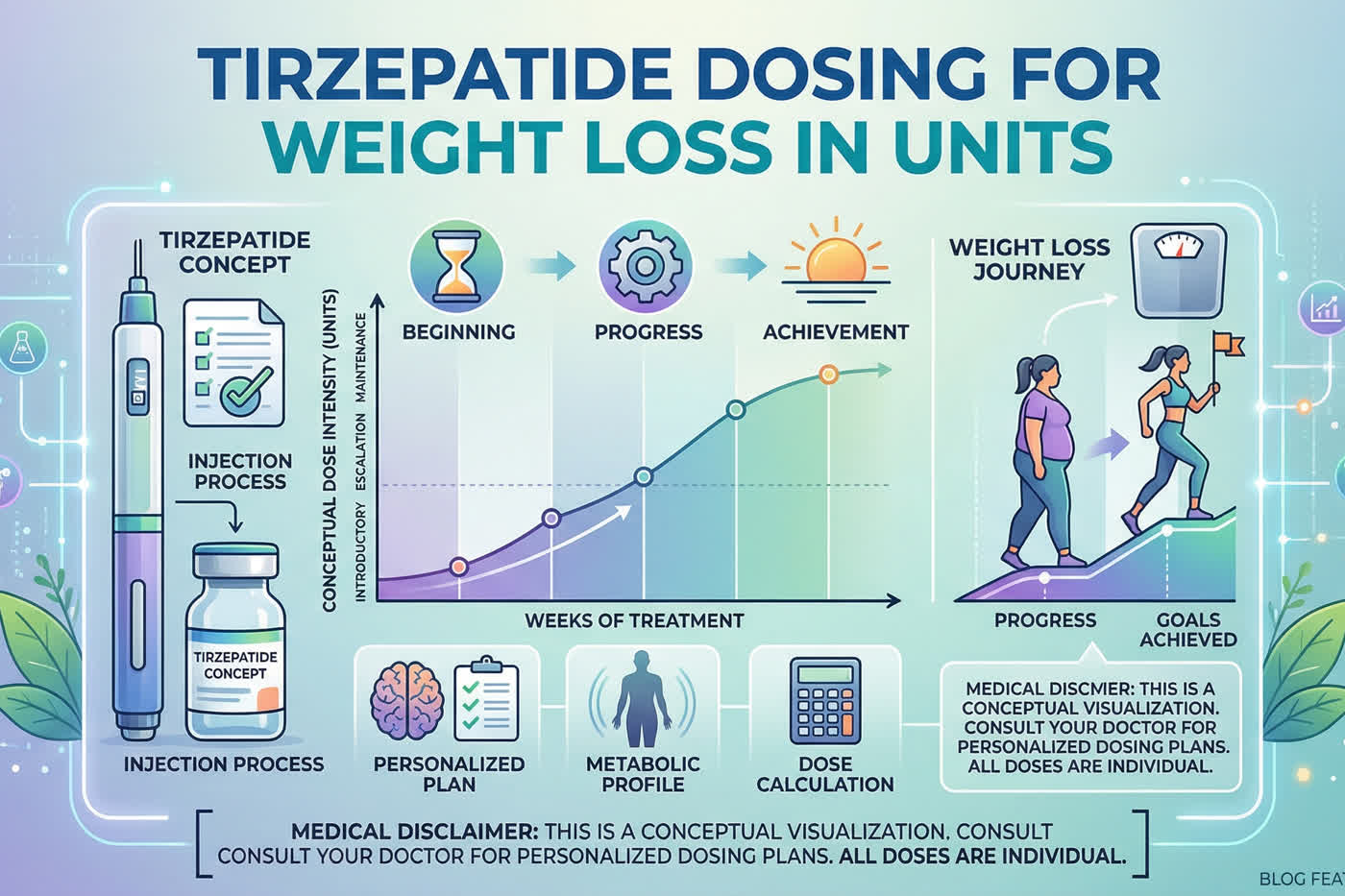
When starting a medical weight loss journey, understanding your exact medication dosage is critical for both safety and effectiveness. If you have been prescribed compounded medication, you won't be using pre-filled auto-injector pens. Instead, you will be using a vial and syringe, which leads many patients to search for the exact tirzepatide dosing for weight loss in units.
Because the official weight loss protocol is based on milligrams (mg), but your syringe is measured in liquid volume (units), translating your dose can feel like learning a new language.
Here is the complete breakdown of the standard weight loss protocol and how to calculate your dose in units.
🛑 IMPORTANT MEDICAL DISCLAIMER: The conversion from milligrams (mg) to units depends entirely on the concentration (mg/mL) of your specific vial. The calculations below are based on the two most common pharmacy concentrations: 10 mg/mL and 20 mg/mL. Always verify your vial's concentration and consult your healthcare provider before drawing your dose.
The official dosing schedule for Tirzepatide (the active ingredient in Zepbound®) is designed to gradually introduce the medication to your system. This "titration" process minimizes gastrointestinal side effects like nausea while maximizing weight loss.
The standard schedule increases your dose by 2.5 mg every four weeks, as tolerated:
Month 1 (Initiation): 2.5 mg weekly
Month 2 (First Step-Up): 5.0 mg weekly
Month 3 (Second Step-Up): 7.5 mg weekly
Month 4 (Maintenance): 10.0 mg weekly
Month 5 (High Maintenance): 12.5 mg weekly
Month 6+ (Maximum Dose): 15.0 mg weekly
To find your exact tirzepatide dosing for weight loss in units, you must look at the concentration listed on your prescription vial. Here is how the standard weight loss protocol translates into units for the two most common concentrations.
This is a standard starting concentration for new patients. In a 10 mg/mL vial, every 10 units on your syringe equals 1 milligram of medication.
2.5 mg dose: Draw 25 units
5.0 mg dose: Draw 50 units
7.5 mg dose: Draw 75 units
10.0 mg dose: Draw 100 units (one full U-100 syringe)
Pharmacies often prescribe a higher concentration as your dose increases so you don't have to inject a large volume of liquid. In a 20 mg/mL vial, the liquid is twice as strong, so you draw half the volume.
2.5 mg dose: Draw 12.5 units
5.0 mg dose: Draw 25 units
7.5 mg dose: Draw 37.5 units
10.0 mg dose: Draw 50 units
12.5 mg dose: Draw 62.5 units
15.0 mg dose: Draw 75 units
One of the most confusing moments for patients is when they move up to a higher dose (e.g., from 5.0 mg to 7.5 mg), but their doctor tells them to inject fewer units than before.
This happens because the pharmacy sent a more concentrated vial. For example, injecting 50 units from a 10 mg/mL vial gives you a 5.0 mg dose. But if your next refill is a 20 mg/mL vial, injecting just 37.5 units gives you a 7.5 mg dose.
This is why you can never memorize your tirzepatide dosing for weight loss in units without also checking the concentration of your current vial. Always read the label of every new refill, and if the math doesn't make sense, contact your prescribing provider immediately.
Would you like me to write an SEO-optimized Meta Title and Description for this section to help it rank for users searching for unit conversions?